
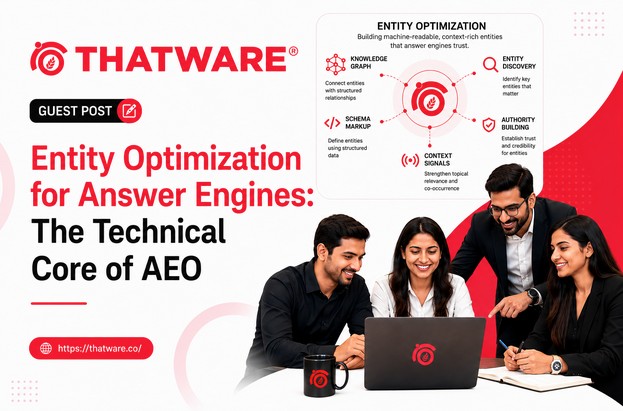

Most conversations about AEO focus on content: write better answers, use Q&A formats, structure your pages clearly. And yes, content matters enormously. But underneath all of it is a technical layer that determines whether AI systems can properly identify, understand, and trust your brand in the first place.
That layer is entity optimization. And it’s the part of AEO that separates the brands with real AI citation authority from the ones publishing great content that largely goes unattributed.
What Is an Entity, Technically Speaking?
In information science, an entity is a clearly defined, uniquely identifiable “thing” — a person, organization, product, place, concept, or event. What makes something an entity (rather than just a word or phrase) is that it can be unambiguously distinguished from other things, has defined attributes, and is connected to other entities through relationships.
Google’s Knowledge Graph is one of the most prominent entity databases — it contains millions of entities with their attributes and relationships, which Google uses to power knowledge panels, featured snippets, and increasingly, AI Overviews. Large language models also have implicit internal representations of well-known entities, built from their training data.
For your brand to be “known” to AI systems in a meaningful way, it needs to exist as a well-defined entity in these systems.
Why This Matters for AI Citation
Here’s the core logic: an LLM asked to recommend brands in a category is more likely to confidently recommend brands that it “knows” — that have clear, consistent, well-defined entity representations — than brands that appear vaguely or inconsistently across its training data.
Think of it this way. If an AI system encounters your brand name in 50 different sources, but each source describes you slightly differently (different product names, different founding dates, different descriptions of what you do), the model’s internal picture of your brand is fuzzy. That fuzziness reduces citation confidence.
But if the same 50 sources consistently describe your brand the same way, with accurate and connected attributes, the model develops a clear, confident entity representation. When a relevant query arises, that confidence translates into more frequent, more accurate citations.
The Components of Entity Optimization
1. Schema Markup
Schema markup is structured data you add to your website’s HTML to explicitly tell search engines and AI systems what entities your content is about and how those entities relate to each other. Key schema types for brand entity optimization include:
- Organization schema: your company’s name, URL, logo, description, founding date, contact information
- Product schema: product names, descriptions, specifications, pricing, reviews
- Person schema: for key executives and authors, establishing them as named, credible entities
- FAQ schema: for question-and-answer content that AI systems can extract directly
- Article schema: for content pieces, with proper authorship and publication attribution
Correct, comprehensive schema markup is one of the clearest signals you can send to AI retrieval systems about what your content covers and who produced it.
2. Knowledge Panel Management
A Google Knowledge Panel is a public-facing entity profile in the Knowledge Graph. If your organization has one, it’s one of the first things AI systems encounter when forming a picture of your brand. Ensuring it’s accurate, complete, and properly attributed — and claiming it through Google’s official verification process — is foundational entity work.
If you don’t have a Knowledge Panel yet, building toward one (through consistent structured data, Wikipedia presence where appropriate, and off-site citation) is a meaningful goal.
3. Information Consistency Across Sources
Every major data point about your organization — your official name, founding date, headquarters location, number of employees, product names, executive names — should be identical across every source where it appears. Your website, LinkedIn, Crunchbase, Wikipedia, press releases, review profiles, industry databases.
Inconsistency is the enemy of entity clarity. And entity clarity is the foundation of AI citation confidence.
4. Off-Site Entity Signals
Entities become more credible and well-connected through their relationships with other entities. A company entity is strengthened when it’s referenced by credible publication entities, when its leadership entities have strong independent profiles, when it’s listed in industry registry entities, and when it’s mentioned in the context of relevant concept entities.
Building these connections deliberately — through PR, executive thought leadership, industry associations, and earned media — is the off-site dimension of entity optimization for answer engines.
A Common Mistake: Treating Entity Optimization as One-Time Work
Entity optimization isn’t a checkbox. Your brand evolves — new products, new markets, leadership changes, acquisitions, pivots. Each of these changes needs to be reflected consistently across your entity presence on the web.
Organizations that do thorough entity optimization at program launch and then never revisit it find that their entity profiles slowly drift out of accuracy. Outdated or inconsistent information about your brand, accumulated over time, erodes the entity clarity you worked to establish.
Build entity maintenance into your AEO program as an ongoing practice, not a one-time project.
How This Connects to Content Strategy
Entity optimization and content optimization aren’t separate work streams — they’re deeply connected.
Your content should consistently reference and reinforce your entity attributes. If your company has a specific founding story, a specific mission statement, a set of named products with specific capabilities — those attributes should appear consistently, and in the same framing, across your content ecosystem.
When AI systems encounter your content and see entity attributes that match their existing picture of your brand, that consistency reinforces their confidence in you as a citation source.
Investing in AEO optimization services that include entity optimization as a core component — not an afterthought — is what separates programs that build durable AI citation authority from programs that just produce more content.
The technical foundation matters. Build it well.